How to Choose a Korean Toner for Sensitive Skin
A guide to textures, key ingredients, and four toners formulated to calm, hydrate, and support reactive skin.
Finding the best Korean toner for sensitive skin means looking for fragrance-free formulas with soothing botanicals, humectants, and barrier-supporting ingredients — and avoiding anything that overloads reactive skin with unnecessary actives. The four toners here cover a range of needs, from deep hydration to weekly pore care, all formulated with reactive skin in mind.
Who This Guide Is For
If your skin flushes easily, reacts to new products quickly, or sits in a constant state of low-level irritation, you already know how hard it is to add anything new to your routine. Toners are often the step people skip when things feel fragile — but a well-chosen toner can actually help stabilize reactive skin rather than aggravate it.
This guide is for anyone whose skin skews sensitive, whether that comes alongside dryness, oiliness, or a tendency toward breakouts. The four toners here are all formulated with that fragility in mind, but they serve different secondary needs. The goal is to help you figure out which one fits where you are right now.
What to Look for in a Toner for Sensitive Skin
Fragrance-free is non-negotiable for most people. Fragrance — synthetic or natural — is one of the most common triggers for skin reactions, and it has no functional benefit. If your skin is reactive, it is worth making fragrance-free status a baseline requirement rather than a bonus.
Texture matters more than you might expect. A watery toner absorbs quickly and tends to feel light on the skin, which suits people who layer products or live in humid climates. A milky or lotion-like toner provides more slip and a richer initial feel, which works well when the skin barrier is compromised and dryness is part of the picture.
Look for ingredients that reinforce the barrier or reduce inflammation. Centella asiatica, houttuynia cordata, and panthenol are common in Korean skincare for exactly this purpose — they appear in many formulas aimed at calming redness and supporting recovery. Humectants like hyaluronic acid, glycerin, and betaine draw water into the skin and help maintain hydration without relying on heavy occlusive ingredients.
Be thoughtful about exfoliating or enzyme-based toners. These can be genuinely useful for congested or pore-prone sensitive skin, but they require a slower introduction. If your skin is currently flared or compromised, hold off until things are calm, then patch test carefully before working them into your rotation.
pH-balanced formulas tend to be gentler on the skin's natural acid mantle. A toner formulated close to skin's natural pH — around 5.5 — can help maintain that environment rather than disrupt it.
The Picks
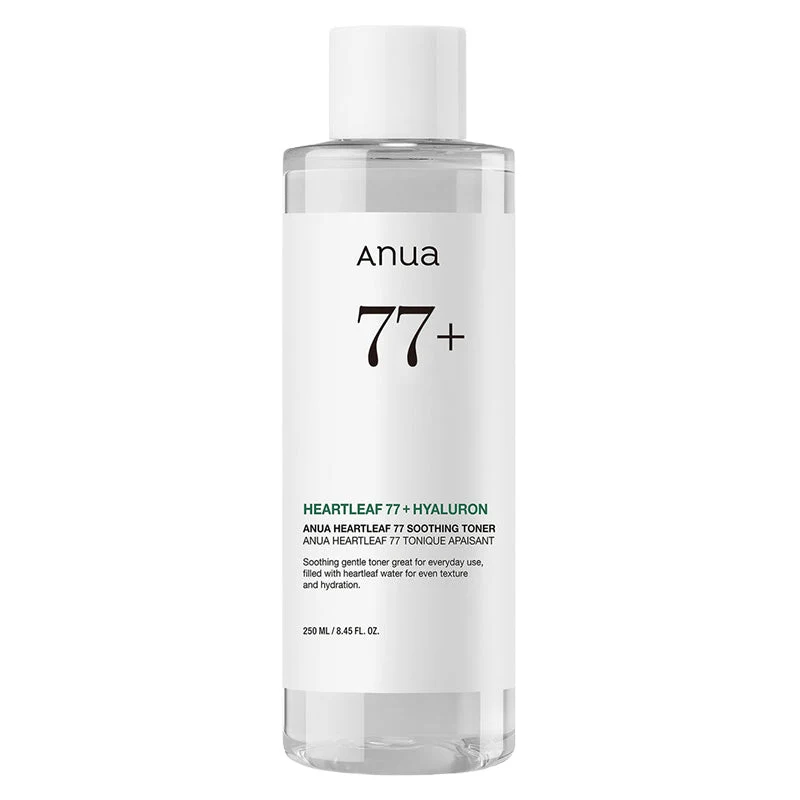
For redness and reactive skin: Anua Heartleaf 77% Soothing Toner
This is the most straightforward choice for anyone whose primary complaint is flushing, redness, or general reactivity. According to the brand, the formula is built on 77% Houttuynia Cordata Flower/Leaf/Stem Water — heartleaf, a plant widely used in Korean skincare for its calming properties — alongside panthenol, centella asiatica extract, and a seven-type hyaluronic acid complex. The texture is watery and absorbs quickly, making it easy to layer. It is fragrance-free, and the brand describes it as vegan and cruelty-free. If you are pregnant, breastfeeding, recovering from a procedure, on prescription medication or managing multiple allergies, check the brand's current guidance and ask your doctor. A standard patch test is still recommended for highly reactive skin before committing to daily use.