How to Choose a Korean Toner for Redness-Prone Skin
A guide to finding the right Korean toner when your skin flushes easily, reacts to fragrance, or struggles to stay calm.
Finding a good Korean toner for redness-prone skin means prioritizing calming botanicals like heartleaf and centella, avoiding fragrance and alcohol, and choosing a texture your skin barrier can actually absorb without reacting. The four toners covered here span different concerns — from basic soothing hydration to targeted sebum and pore care — so you can match the formula to what your skin actually needs.
Who This Guide Is For
If your skin flushes after washing your face, reddens in cold or dry air, or turns pink at the first sign of a new product, this guide is for you. Redness-prone skin can mean different things — a compromised barrier, reactive capillaries, excess sebum causing congestion, or simply a baseline sensitivity to fragrance and harsh actives. The toner step is where many people make or break their routine: the right one can set your skin up to absorb everything that follows without protest, while the wrong one can deepen that redness before you even reach your serum.
This is not exclusively a guide for dry skin or oily skin. Redness appears across all skin types, and the toners below reflect that range.
What to Look for in a Toner When Your Skin Runs Red
Ingredients worth seeking out. The Korean skincare market has a deep bench of plant-derived calming ingredients, and most of them appear consistently across toners made for reactive skin. Houttuynia cordata (heartleaf) and centella asiatica are the two you will see most often — both are associated with soothing visible redness and supporting a stressed skin barrier. Licorice root extract is frequently included for its brightening and anti-inflammatory properties. Panthenol (vitamin B5) helps with barrier repair and immediate comfort. Hyaluronic acid and glycerin provide humectant hydration without heaviness.
Fragrance is the first thing to cut. Synthetic fragrance is one of the most common triggers for reactive skin. If your skin reddens easily, look for toners that are explicitly fragrance-free — not just "minimally scented." Some products use essential oils as a workaround that still carry irritation risk, so reading the full ingredient list matters.
Texture and absorption. A lightweight, watery texture absorbs quickly and layers well, which suits most redness-prone skin. Milkier or cream-toner hybrids can also work well if your barrier is compromised and needs lipid support, but they tend to be better suited to drier, more dehydrated skin than to oily or congested skin types.
Ingredients to be careful with. High concentrations of alcohol (ethanol), strong acids, and physical exfoliants can exacerbate redness for reactive skin. Some exfoliating toners contain fruit enzymes or willow bark that are useful for congestion but should be introduced slowly and sparingly if your skin is already reactive.
pH. Skin sits at roughly pH 4.5–5.5. A toner formulated within that range supports the acid mantle and is less likely to disrupt barrier function. When a product lists its pH, it is worth paying attention to.
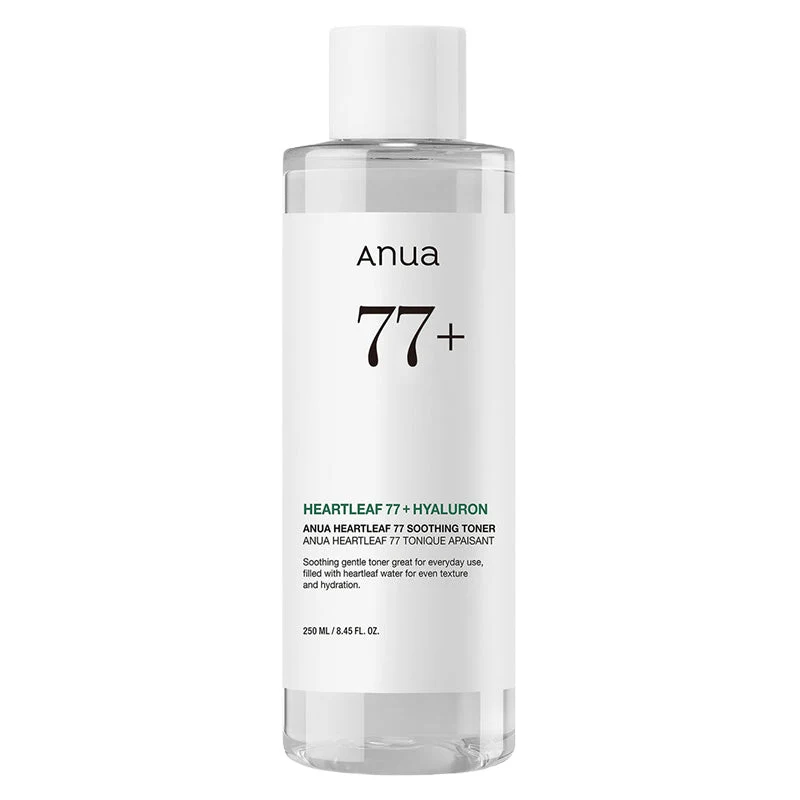
For Everyday Calming Hydration: Anua Heartleaf 77% Soothing Toner
The Anua Heartleaf 77% Soothing Toner is built around one idea: put as much houttuynia cordata into a toner as possible and let it do the work. According to the brand, seventy-seven percent of this formula is heartleaf water, which gives it a light, almost liquid feel that spreads easily and absorbs without any residue. Panthenol and centella asiatica extract round out the calming side of the formula, and a seven-type hyaluronic acid complex delivers layered hydration.